
School Dropout Do-over
Qiu Yuanting
(https://chinarrative.substack.com/p/school-dropout-do-over)
It’s been four years since 17-year-old Jiang Bo* parted ways with conventional education. Village snoops would probably consider him a “delinquent school dropout.”
Jiang Bo had always wondered if other people’s childhoods were carefree, pure, and happy. He knew only hardships: poor grades, scolding, and corporal punishment at the hands of teachers, classmates who bullied and ostracized him, and his parents’ rocky relationship.
In first grade, his teacher told the entire class to ignore “low-grades Jiang Bo.” His classmates duly isolated him.
In third and fourth grade, a newly appointed teacher took a disliking to him, and picked on Jiang Bo, yelling at him to “get lost.”
Because of that experience, Jiang Bo came to detest talking to the other students, saying:
Even now, I still remember that teacher’s name. I really hate him.
In sixth grade, Jiang Bo’s class was assigned the strictest teacher at the school, who was prone to thrashing students with a plastic rod in parts of their bodies not easily seen, and hurling abuse at parents.
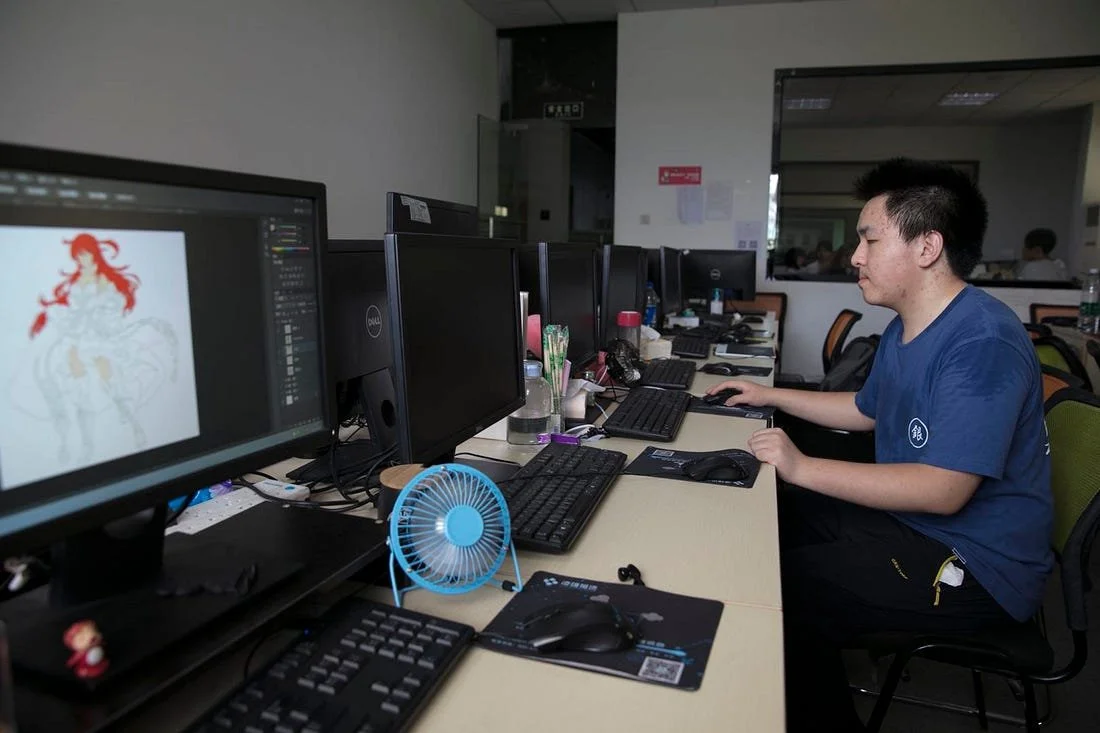
Jiang Bo at work on a computer. Courtesy Southern People Weekly.
As a student at the bottom of his class, Jiang Bo became a special target for this teacher. When the beatings grew fiercer, Jiang Bo would sob, admitting fault, and beg the teacher to stop.
Getting a good teacher hinged completely on luck. He felt especially grateful for his teachers in second and fifth grades. They treated everyone equally, and they were fair and good-natured.
Between 2008 and 2014, this is how Jiang Bo passed six fearful, difficult years of schooling at a public elementary school close to his home in Guiyang [the capital of southwestern province Guizhou].
Homelife was not welcoming either as Jiang Bo’s parents were constantly fighting. Sometimes they directed their anger at him and his having ever been born at all.
For many students like Jiang Bo, quitting school is often the only choice. Although, most people see the decision to leave school as risky, exposing them to discrimination.
But Jiang Bo is different because of his brother, Jiang Wenhua. Jiang Wenhua, who is ten years older, works in innovative education, which uses adaptive or unconventional tools, methods, and practices to better engage students. Under immense pressure from Jiang Wenhua, his parents agreed to let Jiang Bo withdraw.
Older Brother to the Rescue
Jiang Wenhua had to bear his own share of stress. He fought with his parents over pulling Jiang Bo out of school and ended up quarrelling with nearly all of their relatives.
As an educational professional, Jiang Wenhua knew there were ways to opt out of the education system. He had worked in public welfare projects for countryside education since his college years, and after graduating, he founded a small company specializing in innovative education.
Because of his involvement in the welfare sphere of innovative education, he had dealt with many students who were receiving an education outside of the schooling system: homeschooling, innovative micro-schools, or different kinds of vocational training.
Jiang Wenhua reels off the kinds of student who were usually homeschooled: those from Christian families, those whose families opposed educational alienation (where students are estranged, disengaged, or uninvolved in the learning process), and a small number with special education requirements, as well as high achieving top students and those who were unable to adapt to the system.
“My younger brother fully embodies that title of ‘academic bottom feeder,’’’ Jiang Wenhua said with a laugh as Jiang Bo sat on one side, nodding.
When asked: “Isn’t it a blow to your self-esteem to be labeled this way?” Jiang Bo shakes his head.
His brother answers for him:
He knows that you can’t deny that his grades are bad. But certainly that doesn’t mean that he has low IQ.
At the time, Jiang Bo had just entered middle school but was still struggling. A relative, who had pulled strings to get him admitted, told the school to “discipline him well,” so they assigned Jiang Bo to a particular class—one whose teacher had a reputation for strictness.
The teacher hit Jiang Bo on the first day of school because he had a small scuffle with a new classmate about seating. Eventually, everyone in the class had suffered punishment by way of the teacher’s steel ruler. In the wintertime, the teacher would even force students to soak their hands in ice water for five minutes until they swelled before hitting them with the steel ruler.
Hitting and kicking became the norm. At the height of one of his rages, the teacher shoved a student from the podium to the back of the classroom, knocking over a couple of tables along the way.
Jiang Bo recalled another time when a male student made a mistake in class. To punish him, the teacher had all the other boys in the class take turns at hitting the student.
Jiang Bo said that he had gotten along well with that student.
When asked whether he had hit that student, Jiang Bo answered:
There was nothing I could do, except go a little easier on him and say sorry. But you know, this was a top teacher in the province.
The only redeeming feature of that teacher was that he once stood up for Jiang Bo in a matter involving the school’s office. For that, Jiang Bo felt fleeting gratitude.
From then on, Jiang Bo said he that tried as much as possible to avoid teachers who didn’t have children of their own.
His mother was friendly and meek in her interactions with his teachers while his father was too busy with his work to bother.
His older brother, who was in college at the time, had to be both a father and brother figure to Jiang Bo, so he shouldered the responsibility of Jiang Bo’s schooling.
The teacher had a rule that students would have to write a hundred lines for each mistake made in English listening exercises. Jiang Bo’s 25 mistakes meant he had to write 2,500 lines. Unable to just stand by, Jiang Wenhua helped his brother write until they finished at 2 am.
Jiang Wenhua had a talk with the teacher, but it went nowhere. After giving it some consideration, Jiang Wenhua felt that perhaps he should put his foot down and take his younger brother out of the conventional schooling system.
Discussing withdrawal with his parents was a matter of presenting the facts and reasoning things out. With relatives and acquaintances, it was nothing more than an issue of face (keeping up of appearances).
Older relatives took turns dissuading them, but Jiang Wenhua deflected their criticisms and countered every argument by repeating, “You don’t pay for it, so it has nothing to do with you.”
For him, the hardest part of convincing his parents was not necessarily the issue of Jiang Bo’s future. In fact, that turned out to be the easiest point of attack once Jiang Wenhua laid out his brother’s grades and experiences before them.
Forced to consider Jiang Bo’s prospects, they easily recognized that he had no chance at getting into college by taking the gaokao, the college entrance exam.
Nor could an ordinary family like theirs afford to send their son abroad to study.
Jiang Wenhua strove to convince his parents that “unless you worked within the education system” as teachers or instructors, a diploma was growing increasingly unnecessary in current and future society.
Instead, abilities, resources, and connections were key factors. Since Jiang Bo’s situation would only worsen if he stayed in school, would it really hurt to let him try a different route?
A Short-Lived Freedom
After Jiang Bo provided the school with his medical certificate, they released him. In the blink of an eye, he was no longer a registered student. While everyone else shouldered their backpacks and headed to class, he could finally stay at home and just play computer games.
Jiang Wenhua gave his brother two months to relax, until Jiang Bo himself finally got bored. At the time, Jiang Wenhua, who was in college, was planning a motorcycle trip to the Xinjiang Uyghur Autonomous Region, located more than 3,400 kilometers northwest of their hometown, Guiyang. Since Jiang Bo was lounging around at home, it made sense to invite him on the initial leg of the trip and drop him off in Chengdu, only 652 kilometers northwest and along the same route to Xinjiang.
Those three days on the road were some of Jiang Bo’s happiest times—and one of the safer stretches of Jiang Wenhua’s trip. Jiang Bo slept a lot and would often nod off on the back of the motorcycle, his arms wrapped around his brother. This forced Jiang Wenhua to drive carefully, lest his brother fall off. Later, when he motorcycled solo around Xinjiang, Jiang Wenhua got into a speeding accident. He told Jiang Bo earnestly, “Maybe this wouldn’t have happened if you had been riding with me.”
They also had their share of conflict. Once, when Jiang Wenhua got angry, he dropped Jiang Bo off in a small village, told him to find his own way back to Guiyang, and immediately rode off. But Jiang Bo stayed where he was, waiting until his brother had a change of heart and came back for him.
Another time, they suddenly encountered pouring rain that filled the streets with mud and caused the manholes to overflow. They rode for an hour in the mud and rain without seeing another soul or finding shelter. During their trip, they also passed fields of sunflowers and rapeseed along the national highway. They would chat with the farmers selling watermelons by the roadside, who taught them how to knock on a melon and listen to its sound.
Reminiscing brought back all these memories for Jiang Bo. Even the difficulties he was experiencing at the time became lighthearted recollections, prompting Jiang Bo to conclude that traveling via motorcycle was more fun than driving. When their journey drew to a close and Jiang Bo arrived at the Chengdu airport, he still had his motorcycle helmet strapped on.
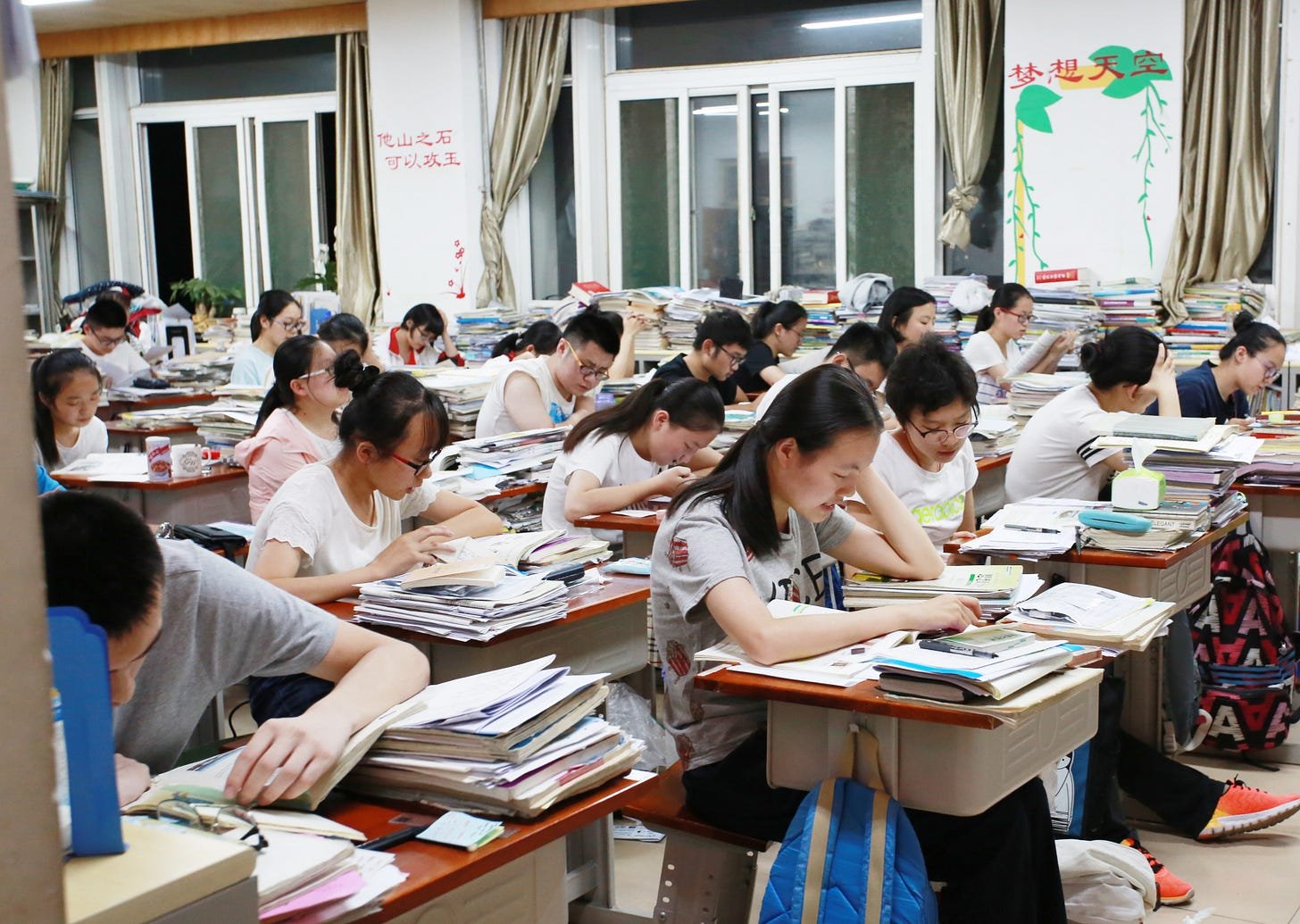
Chinese students prepare for the national college entrance examination on June 7, 2017.
Credit: ImagineChina.
September approached. Unable to live with the idea that their son might not graduate or receive a diploma, Jiang Bo’s parents began having second thoughts as a new semester unfolded before their eyes. Unbeknownst to Jiang Wenhua, his parents recruited their uncle to oversee Jiang Bo’s education and offered him 150 yuan ($22) a month as an incentive. They wanted Jiang Bo to re-enter the public school system, this time at the newly opened public middle school in their old county.
Because it was his second round of sixth grade, Jiang Bo became the star student for a while. But after soon falling behind in math and English, he turned against studying altogether. On top of that, Jiang Bo had relocated from a major city to a rural village. He wore clothes that were normal for the city but marked him as a “rich kid” in the countryside. This drew special attention from teachers, while other students privately felt that he was flaunting his wealth.
At first, Jiang Bo reveled in his “rich kid” status, with so many students trying to curry favor with him. Suddenly, money was a means of achieving social fulfillment. He invited his classmates to the movies, treated them to snacks, and added money to their computer game accounts. When he ran out of money, he would steal from his parents. If he had asked them for money, they would have scolded him.
He admitted to having bad habits like laziness and lying, but then he would quickly direct his ire at his family, saying: “I hate the lies I blurt out sometimes, and I want to change. But Dad promised to take me to an amusement park when I was 6. I’m in sixth grade now and still haven’t gone. He tells me to be disciplined, obedient, and clean, but he doesn’t even do any of that himself. I think there are words and then there are actions, which are two separate things altogether. It’s hard to change once your habits become fixed.”
Jiang Wenhua heard in a roundabout way from a friend’s friend that Jiang Bo had returned to school. Jiang Bo had never seen such anger from his older brother, who called and “chewed me out for a while [as he was road-tripping] on the Sichuan-Tibet Highway.” Right after that, Jiang Wenhua yelled himself hoarse at their parents.
Looking back, Jiang Wenhua felt that his outburst stemmed from his own fears. Was his decision truly in his brother’s best interest, or was it just motivated by his desire for control? Although he insisted on making this decision in place of his parents, he had no way of securing his sibling’s future. If he failed, he had only himself to blame. It was sink or swim for Jiang Wenhua and Jiang Bo.
The Academy
Jiang Wenhua had to give serious thought to Jiang Bo’s educational options after withdrawing him from school yet again. It was the winter holiday then, so he first sent Jiang Bo to a weeklong winter camp at Jianchuan Museum in Chengdu. Afterward, he returned to Chengdu and spent a month happily couch-surfing, watching movies, strolling through parks, and visiting [the tourist town of] Dujiangyan.
At the winter camp, Jiang Bo befriended a classmate who attended the Xianfeng School in Chengdu, a leading institution in creative education whose curriculum focused on independence, critical thinking, and flexibility.
The vast majority of those sorts of schools offered only preschool and primary education because a lack of resources, funding, experience, and other problems limited their expansion into secondary education. The Xianfeng School, however, was one of the older, more developed secondary schools. An insider who had previously visited Xianfeng told me that it had an independent spirit. With all the love, freedom, and trust from the school, so-called problem youth were able to realize their potential.
Jiang Wenhua, who had previously heard of Xianfeng and had considered it, encouraged Jiang Bo to experience the school for himself and then decide. He and a friend toured the campus and found that classes and assignments were all voluntary, even though the school operated on an academic credit system. Jiang Bo was a little worried that it would be a rigorous system, and because he had zero confidence in his self-discipline, he decided to look at other schools instead.
F Academy (a pseudonym) in Guiyang soon came onto his radar. In terms of scale, it was more like a private school. It had two buildings, one for classrooms and one for dorms, along with a social activities center. Jiang Bo recalled that during his visit, he saw 11 or 12 very different students all mixed together in the same class—some in middle school and others in high school, their ages ranging from 11 to 18. Jiang Wenhua audited their classes and came away with a good impression.
The academy advocated holistic education; the classes centered around discussion and practicum; and the wide-ranging curriculum included Cambridge English, archery, yoga, vocals, drama, arts, and more. Every Friday, F Academy organized study-abroad programs and outdoor field trips, or would invite guest speakers to share their experiences of working in various industries.
The two brothers persuaded their parents to pay tens of thousands of yuan for tuition. Then Jiang Bo moved to the school and began his third round of sixth grade. The headmaster actually slept in the bunk under Jiang Bo’s. The academy wanted to create the atmosphere of a happy family, so it gave students the autonomy to create their own rules and collectively enforce them.
But Jiang Bo soon realized that where there are people, there are politics—and the fewer the people, the harder it is to avoid the politics.
He witnessed a male high school student drag someone into the hallway and beat him, so he told a teacher in confidence. But in dealing with the problem, the teacher named Jiang Bo as the source, which turned him from the newcomer into the tattletale and traitor of the group. He would get hit with the ball in basketball class; another time, a group of classmates marched him off into the underbrush and threatened to cut off his hands.
Jiang Bo felt that he had dealt with a wide variety of people, but the kind of people he truly couldn’t stand were those whose sunny, harmless countenance belies a conniving, two-faced side. Even though their teachers would engage meaningfully with them, Jiang Bo grew more and more disappointed. At best, that kind of counseling only eased people’s emotions in the moment but never really resolved the core issue.
The teachers even casually broke the first rule that had existed when Jiang Bo was admitted. Originally, everyone had agreed that the normal routine for middle school classes was studying in the morning, reading and watching films in the afternoon, and doing independent study in the evening. Then one day, the teachers impulsively announced that everyone would have to get up at 7 a.m. to run, starting the next day. Their deliberative democracy had given way to absolute rules.
The headmaster, who was once a basketball coach in his former province, highly valued fitness and personally oversaw the morning runs. In retrospect, though, improving his fitness turned out to be Jiang Bo’s greatest accomplishment from the academy. Running 500 meters used to leave him winded, but he gradually progressed to running 4 kilometers and then up to a quarter marathon.
Then he witnessed the headmaster who, in a fit of rage, hit a table so hard that it broke in front of everyone. Jiang Bo suddenly realized the gap that existed between him and the headmaster, who had referred to Jiang Bo and himself as “bunk-bed brothers.”
Was this really one big family? Jiang Bo had seen teachers break the rules and the headmaster lash out in rage. Sometimes, he felt that the “big, happy family” label was simply there to brainwash the students and keep them enrolled at the school.
Jiang Bo cried for a while in his room, struggling to decide whether to stay or go. In spite of all the school’s problems, Jiang Bo had had a relatively happy, successful two years at F Academy, compared with his experiences at other schools. He still remembers the presentation he gave on a study trip to Chongqing [municipality in southwestern China]: He could feel his improvement in every step of the process, from brainstorming and design to the actual presentation, and it boosted his sense of independence as well.
Still, he eventually decided to shake off the fetters of this “big family.”
Homeschooling
The catalyst for Jiang Bo’s departure was his older brother’s dissatisfaction with the class changes. Jiang Bo had originally found the classes “pretty fun,” but they gradually changed over the year, becoming increasingly similar to traditional curriculums. They were now studying language, math, and English in the morning, then biology and physical education in the afternoon. They had more assignments, and they even had to prep for the senior high school entrance exam.
Jiang Wenhua saw this change as the result of chaotic classroom management. “Under pressure to use up all 10 hours of the children’s days,” classes were clearly underprepared. He had a discussion with the school about this issue, but it went nowhere. Two other families were equally unhappy, so they decided to contribute 20,000 yuan ($2,900) per family and homeschool their three children together.
But Jiang Wenhua heard his younger brother sobbing before they left. It was Chinese New Year then. He knocked on his door and after learning why Jiang Bo was crying, he got a piece of paper and a pen, saying, “Let’s make a pros and cons list of F Academy versus homeschooling with the three families.”
This was a thinking tool that Jiang Wenhua had learned at work and that Fengwo School, a learning platform for children, often applied in its classes. After Jiang Bo calmed down, they started making their list.
The disadvantages of the three-person homeschooling group was a limited network, a potentially narrow pool of knowledge, and inadequate self-discipline. The advantages of the academy were the sentimentality of staying and the chance to widen his horizon, but its irredeemable disadvantages were its learning environment, the way instructors treated students, and the school’s approach to problem-solving.
Jiang Wenhua wanted Jiang Bo to make the decision on his own, rather than making the “right” choice on his behalf.
In March last year, under the supervision of one of the parents, the three male students who had left the academy rented a place together and set their own study schedule. They would wake up at 8 a.m., make breakfast, and read all morning. In the afternoon, they would work out, either playing basketball for at least one hour, running no less than 4 kilometers, or lifting weights.
For reading, Jiang Bo preferred fiction, like the works of Keigo Higashino or Agatha Christie, the Chinese sci-fi novel The Three-Body Problem, or The Moon and Sixpence, but he usually asked his brother for book recommendations.
Their plan went smoothly at first, but it didn't take long for their discipline to slip. They would start playing computer games whenever the parent wasn’t around, so they ended up carrying out their study plan only three or four days out of every five days. Before six months had passed, this casual group of homeschoolers disbanded, with the other two students pursuing different goals.
One of them would attend cram classes to prepare for the senior high school entrance exam, while the other boy would become a professional bowler. They originally had different reasons for leaving the academic system as well. The first boy was like Jiang Bo, a passive “school dropout” at odds with exam-oriented education. The second boy left because of his parents’ frustration with the exam system and sought change more proactively.
These real-life cases reflect the data found in studies. According to the Report on Homeschooling in China (2017), 68.66 percent of home-schooled students “had received a certain level of in-school education and usually had an unhappy academic experience at school.” In opting to homeschool their children, 73.13 percent of parents said that they “disagree with the school’s teaching philosophy,” closely followed by 71.64 percent of parents who “disagree with the school’s teaching methods.” In terms of duration, though, only 24.63 percent of homeschooled families were able to last for two years or more.
Jiang Bo was still trying to find a path for his future. The results from his career planning at F Academy had suggested trade school. He was interested in playing guitar at the time and, after speaking with Jiang Wenhua, felt that there was potential in becoming a guitarist. But he found it “tiring” after learning it for half a year. Apathy settled in, and he quit.
Jiang Wenhua had steered the course of his younger brother’s school withdrawal, but he felt that he needed to tell their parents in order to figure out a direction soon for Jiang Bo. Jiang Bo was still two years away from becoming an adult, and the age of 18 loomed like a stark deadline. Jiang Wenhua had to help his younger brother to find a direction for his future that would at least have the semblance of a livelihood.
The Light at the End of the Tunnel
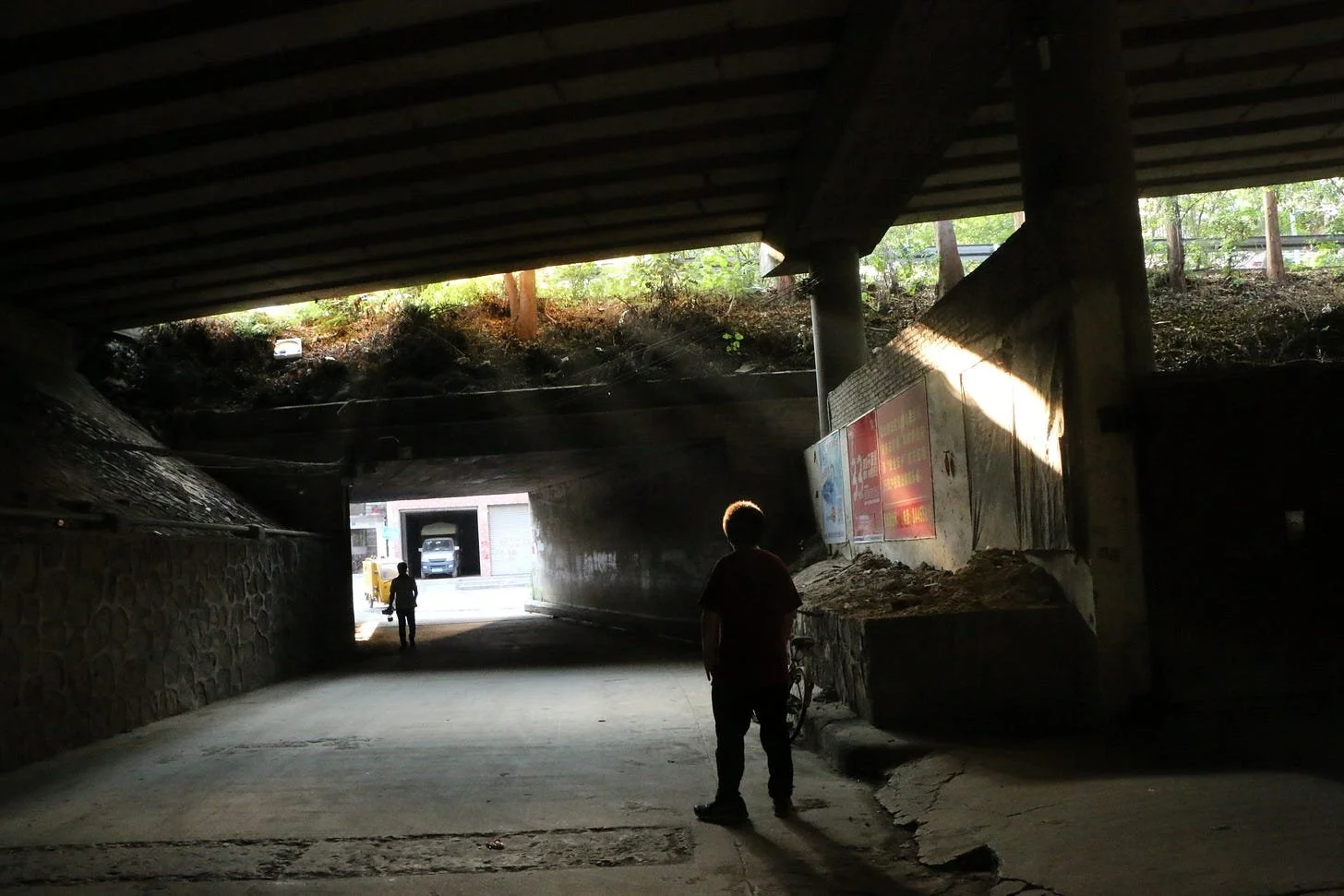
Jiang Bo in a reflective moment (back facing camera). Courtesy Southern People Weekly, photographed by Qiu Yuanting.
Jiang Bo began reconsidering vocational school anew. Given his interest in gaming and animation, he thought about game design for the first time. But he was frustrated with his online search for openings, as well as relevant schools, because jobs in that sector largely sought graduates of Chinese literature and language or film and television screenwriting. They also had certain requirements for literacy and education. In addition, education companies like Xinhua Computer College and Beijing Aptech Beida Jade Bird either lacked those programs or carried courses that Jiang Bo deemed were “weak.”
After the homeschooling trio disbanded in August last year, Jiang Bo spent two weeks hanging out in Guangzhou with Jiang Wenhua, whose respect of Jiang Bo’s initiative grew. Jiang Bo, who was considering animation design, used suggestions and information from a friend to narrow his options down to three animation schools in Guangzhou. Weighing his own ability and skill level, he ruled out one more, then phoned the remaining two schools with questions and made appointments to visit their campuses. He ended up choosing the school that was slightly more expensive and bigger. It also offered a better learning environment.
But after paying tuition and going to class, he realized that their teaching method of live-streaming the classes and gliding over fundamentals left him—a beginner with no grasp of the basics—lagging behind. Consequently, he negotiated with the school for a refund and transferred to another school.
Jiang Wenhua said proudly of his brother’s growth:
He managed this entire process by himself, from beginning to end.
In October, Jiang Bo officially moved to Guangzhou to a shared dorm near the his animation school. He took care to pack his three most valuable model figure kits: an unpainted figure set, a collector’s model, and an anime model. The school was situated in one of Guangzhou’s newly developed districts, which had glass skyscrapers and a central business area on one side of the street and one-storied homes and construction sites on the other. Jiang Bo lived on “the other side.”
The 15-minute walk from the school to his dorm traversed the narrow alleys between the skyscrapers, algae-ridden pools of standing water, and train tunnels. His tiny, single apartment was designed only with one bedroom, one living room, and one bathroom, but it was split into two dorm rooms. Jiang Bo resided in the living room, which had a kind of steel bunk bed commonly seen in college dorm. He slept in the lower bunk and stacked his personal belongings in the upper bunk. His computer sat on a wooden table next to the bed. His beloved kits were placed between his laundry detergent and his body wash. His roommate, who was considerably older than him, often said with envy, “I can’t believe you’re only 17.”
Jiang Bo learned set design first before transferring to character design. His initial enthusiasm lasted for about three months. At the height of his diligence, he would wake up at 5 a.m., head to the computer room, and work on designs there until he returned to his dorm around 10 p.m. As he worked, he would listen to Japanese ACG (anime, comics, and games) songs through his headphones. Back then, he solemnly swore to all his friends on QQ, “I am going to become an anime designer in the future!”
But lethargy crept in. He began waking up later, sometimes not getting up until 10 a.m. for a 9:30 a.m. class and then rushing over. He was sometimes gripped with the fear that he would repeat his past failures:
Will I end up quitting halfway like I did with guitar?
His course was only a crash course. Although Jiang Bo recognized that he still lacked a solid foundation in drawing, he had to collect samples of his works anyway and start submitting his resumes to internships or full-time jobs, even if the salary was low. That was his consensus with Jiang Wenhua. Jiang Bo’s short-term goal was to prove himself by taking this class, after which he would seek opportunities to build upon that foundation or continue pursuing his art studies.
He fretted over writing his resume. The teachers at the animation school told him that resumes could be padded as appropriate, but he wondered if he should be honest about his academic background. How much would the employer care about one diploma? He had no way of knowing until he had some experience under his belt.
As he talked about this, he was on his way from his dorm to the computer room. He made his way through the dimly lit tunnel, the bright beams of the setting sun spilling through the upper cracks. Jiang Bo was originally awash in the darkness but continued moving forward, step by step, his head held high amid the dazzling sunlight.
* Jiang Bo and Jiang Wenhua are pseudonyms.
Translator: Katherine Tse
